

CanIDrinkTheTapWater.com now has complete tap water safety coverage across Europe — 49 countries covering every destination from the Atlantic coast to the Caucasus. Whether you’re planning a city break, a Balkan road trip, a Scandinavian adventure, or a mountain ski holiday, there is now a dedicated guide for every European country on the site.
Where It Started — The Original 20
Europe coverage began with the continent’s most searched travel destinations. The first 20 countries established the backbone of the site’s European guides, covering the destinations that collectively attract hundreds of millions of visitors every year.
France, Germany, Spain, Italy, and Greece were among the first covered — five of the world’s most visited countries, each with distinct water safety profiles. France and Germany have excellent tap water that is safe to drink throughout; Spain and Italy are safe in most areas with some regional nuance; and Greece is one of Europe’s most variable countries, where tap water is safe on the mainland but not on many of the islands.
The original 20 also included United Kingdom, Portugal, Netherlands, Switzerland, Austria, Sweden, Norway, Iceland, Ireland, Poland, Czech Republic, Hungary, Romania, Croatia, and Turkey. These countries span the full spectrum of European water safety — from Iceland, which has arguably the best tap water in the world sourced from geothermal springs, to Turkey, where tap water is not recommended for direct consumption despite adequate treatment in major cities.
The Next Wave — High-Traffic Additions
The next phase expanded coverage to some of Europe’s most searched destinations that had been missing from the site. Belgium — home to Brussels, Bruges, and Ghent — joined alongside the Nordic countries Denmark and Finland, both of which have world-class tap water quality that is a genuine source of national pride. Denmark’s entirely groundwater-based supply and Finland’s extraordinarily clean lake-fed water are standout stories in European water quality.
Slovakia and Slovenia added two of Central Europe’s most beautiful and most searched destinations. Slovenia’s Lake Bled is one of the most photographed places in Europe, and the country itself has the highest per-capita freshwater resources in the EU — Ljubljana was also the first European capital to commit to free public drinking water across the city. Estonia completed the Baltic trio, covering Tallinn’s UNESCO Old Town and its EU-standard tap water supply.
This phase also added some of Europe’s most popular sun and beach destinations. Cyprus and Malta — two small Mediterranean islands that are among the UK’s most popular holiday destinations — both have safe tap water that meets EU standards but rely so heavily on desalination that the taste drives virtually all residents and visitors toward bottled water. Bulgaria’s Black Sea resorts and Serbia’s Belgrade — one of Europe’s fastest-growing city break destinations — rounded out this batch.
The Balkans, Baltics, and Beyond
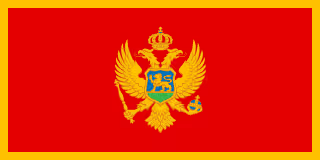
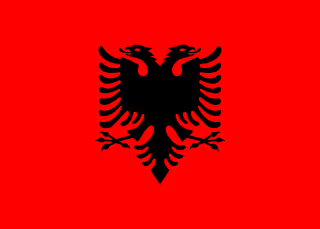
Coverage then expanded into the Balkans and Eastern Europe, adding destinations that have seen enormous growth in visitor numbers in recent years. Montenegro’s Bay of Kotor and Albania’s Albanian Riviera are two of the Mediterranean’s hottest emerging destinations, with Albania in particular experiencing extraordinary growth as a budget-friendly alternative to Croatia and Montenegro. Neither country’s tap water is recommended for direct consumption.
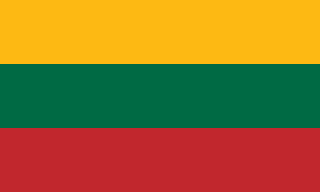
Latvia and Lithuania completed the Baltic states, with Riga’s Art Nouveau architecture and Vilnius’s baroque Old Town both being heavily searched European city break destinations. Both have EU-standard safe tap water. Russia was also added — covering Moscow and St Petersburg’s water infrastructure alongside the current travel advisory context — noting that bottled water is the universal choice for all visitors.
Eastern Europe and the Caucasus
The final major expansion covered Eastern Europe’s remaining destinations and the Caucasus nations. Georgia is one of the Caucasus’ fastest-growing tourism destinations, with Tbilisi’s vibrant food and wine scene attracting increasing numbers of visitors — and Borjomi, its famous volcanic spring mineral water, is one of the most recognised brands in the post-Soviet world. Armenia and Azerbaijan complete the Caucasus trio, with Baku’s ultra-modern skyline and ancient Old City making it an increasingly prominent destination.
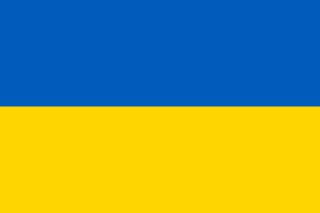
Ukraine was added with particular care, covering both the pre-existing water infrastructure challenges and the significant additional damage caused by the ongoing conflict. Moldova — rapidly developing as a wine tourism destination with some of the world’s largest wine cellars — has some of Europe’s worst water infrastructure, with a documented rural nitrate contamination crisis alongside general distribution challenges. Belarus was added with appropriate travel advisory context given the country’s current political situation.
Bosnia and Herzegovina’s guides highlight the contrast between Sarajevo’s mountain spring supply — considered among the best in the Balkans — and the variable infrastructure elsewhere in the country. North Macedonia’s guide covers Lake Ohrid, one of the world’s oldest and most biodiverse lakes and a destination that generates significant search volume. Kosovo — one of Europe’s youngest countries — and Luxembourg — one of its smallest and wealthiest — were also added in this phase.
The Micro-States
Europe’s coverage was completed with the four micro-states. Andorra’s Pyrenean mountain spring water, Liechtenstein’s Alpine supply equivalent to neighbouring Switzerland, Monaco’s French Riviera-sourced water, and San Marino’s Monte Titano spring water are all completely safe to drink. All four are quick-reference guides for visitors to some of Europe’s most intriguing destinations.
All 49 European Countries Now Covered
Western Europe: Andorra · Austria · Belgium · France · Germany · Ireland · Liechtenstein · Luxembourg · Monaco · Netherlands · Portugal · Spain · Switzerland · United Kingdom
Northern Europe: Denmark · Estonia · Finland · Iceland · Latvia · Lithuania · Norway · Sweden
Southern Europe: Albania · Croatia · Cyprus · Greece · Italy · Malta · Montenegro · San Marino · Slovenia
Central & Eastern Europe: Belarus · Bosnia and Herzegovina · Bulgaria · Czech Republic · Hungary · Kosovo · Moldova · North Macedonia · Poland · Romania · Russia · Serbia · Slovakia · Ukraine
Caucasus: Armenia · Azerbaijan · Georgia
Turkey: Turkey

.svg)
