

Can I drink the tap water in South America
Water safety guides for South American countries covering the entire continent from Colombia to Argentina.
Jump to Popular destinations
Argentina
South America
Brazil
South America
Colombia
South America

French Guiana
South America
Guyana
South America
Paraguay
South America
Suriname
South America


FAQ & Questions!
Which South American country has the safest tap water?
Uruguay and Chile have the safest and most reliable tap water in South America. Uruguay has near-universal safe tap water nationwide, while Santiago and most of Chile's cities have well-treated water that locals drink without hesitation. Argentina's Buenos Aires is also generally safe.
Which South American country has the most unsafe tap water?
Venezuela has the most severe water crisis in South America, with collapsing infrastructure, frequent supply outages, and widespread contamination across the country. Bolivia and Peru also have significant challenges outside their major cities, particularly in rural areas.
Why does altitude affect tap water safety in South America?
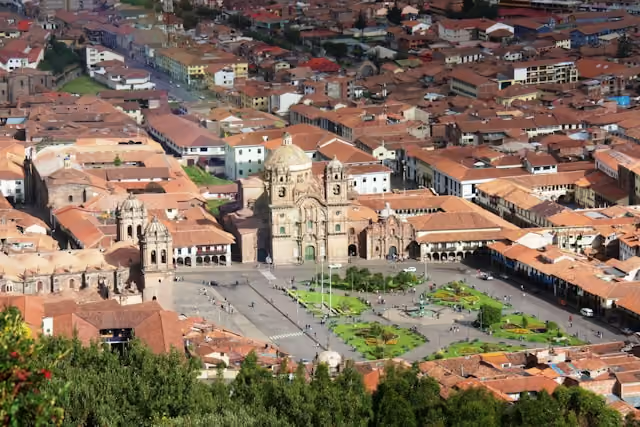
At high altitudes in the Andes — such as in Cusco, La Paz, and Quito — water boils at a lower temperature (below 100°C), meaning standard boiling times are less effective at killing pathogens. Travellers using boiling as their purification method need to boil for longer at altitude.
What is soroche and is it related to water?
Soroche is altitude sickness, common among travellers arriving in high-altitude cities like Cusco and La Paz. While not caused by water directly, staying well-hydrated is important for acclimatisation, and drinking only safe bottled water at altitude is essential since tap water in these areas is generally not safe.
Is tap water safe in South American capital cities?
It varies. Buenos Aires, Montevideo, and Santiago have safe tap water. Bogotá and Quito are generally safe. Lima, La Paz, Caracas, and Asunción are not recommended for visitors. Brazil's major cities like São Paulo and Rio de Janeiro are technically treated but most visitors use bottled water.
We don't conduct independent water testing. We summarises and interpret publicly available official data. Conditions can change rapidly — always verify with local authorities before travelling.