

Can You Drink Tap Water in Auckland?
Complete Drinking Water Safety Information for Auckland
Auckland's tap water is safe to drink and is managed by Watercare Services Limited, Auckland's publicly owned water utility. The city's supply draws from two primary catchment systems: the Hunua Ranges in South Auckland, which supply approximately 70% of the city's water via the Mangatangi and Mangatawhiri reservoirs, and the Waitākere Ranges on the city's western edge, which supply the remaining 30% via the Upper Nihotupu, Lower Nihotupu, and associated reservoirs. Both catchment areas are designated water supply protection zones with strictly controlled access — no farming, no development, and limited recreational use — ensuring the source water is of exceptional natural purity. All water from these sources is treated at the Ardmore Water Treatment Plant in South Auckland — Watercare's primary and largest facility — and the Huia Water Treatment Plant in the Waitākere Ranges, using coagulation, sedimentation, filtration, UV sterilisation, and chlorination before distribution throughout Auckland's metropolitan network. The water consistently meets and substantially exceeds New Zealand Drinking Water Standards.
Auckland's tap water is exceptionally soft — a product of rainfall collecting over the volcanic and sandstone geology of the Hunua and Waitākere Ranges with minimal mineral uptake. Total dissolved solids are typically 30–70 mg/L, placing Auckland's water among the softest major city water supplies in the world. This softness gives the water a very light, clean, almost neutral character that most visitors find outstandingly pleasant — noticeably different from the harder, more mineral-heavy water of cities like London, Rome, or Barcelona. Auckland's water is of such quality that it is considered a point of civic pride — Watercare regularly highlights that Auckland's tap water outperforms many premium bottled water brands in independent taste tests.
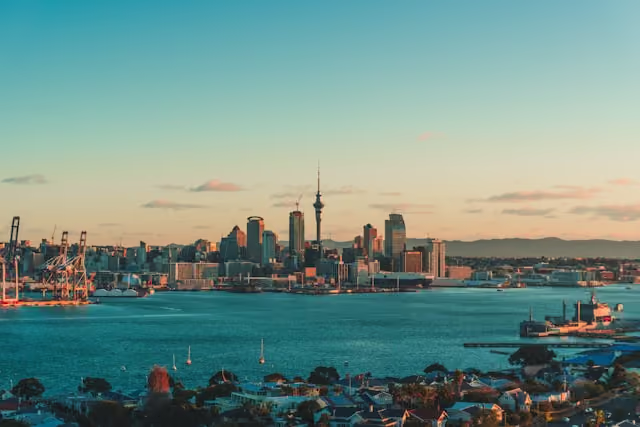
The water quality is consistent throughout Auckland's diverse urban geography — from the CBD, Ponsonby, Grey Lynn, and Newmarket through to the North Shore suburbs of Takapuna and Devonport (accessible by ferry across the Waitematā Harbour), the eastern suburbs of Parnell and Mission Bay, and the southern suburbs of Manukau and Papakura. Hotels, restaurants, cafes, and bars across all of Auckland's neighbourhoods draw from the same Watercare network, and the water is safe at every tap regardless of accommodation category or neighbourhood. Watercare publishes detailed annual water quality reports available publicly online.
Auckland has a strong culture of tap water consumption. Public drinking fountains are available throughout the CBD, parks, and major visitor precincts including the Viaduct Harbour, Queens Wharf, the Auckland Domain, and Mission Bay beachfront. Carrying a reusable bottle and refilling freely at taps and public fountains is standard practice for Aucklanders and an entirely safe approach for any visitor. Restaurants in Auckland — from casual cafes in Ponsonby to fine dining in the CBD — routinely provide tap water at the table without being asked, and requesting tap water is entirely normal throughout the city's hospitality sector.
For visitors exploring beyond Auckland — on day trips to the Coromandel Peninsula, Northland, the Waiheke Island ferry crossing, or the thermal regions of Rotorua and Taupo — tap water is equally safe throughout New Zealand, which has one of the world's most consistently excellent national water supply systems. New Zealand's pristine natural environment, low population density, and comprehensive regulatory framework combine to produce tap water of outstanding quality across the country.
Bottled Water Information
Bottled water is widely available across Auckland but entirely unnecessary for health reasons. Pump, produced by Frucor Suntory New Zealand from South Island alpine springs, is New Zealand's most popular still water brand, available at every Countdown, New World, Pak'nSave, and Four Square across the city. Pure and Antipodes (a premium New Zealand artesian water from Northland) are also widely available. A 600ml bottle costs approximately NZD $2.50–$4.00 at convenience stores. The only reason to buy bottled water in Auckland is personal preference or the convenience of a portable sealed container — the tap water is completely safe and free.
Is Ice Safe in Auckland?
Ice in Auckland is completely safe at all establishments without exception. Watercare's exceptionally soft, clean Hunua and Waitākere Ranges catchment supply is free from biological contamination and meets New Zealand Drinking Water Standards throughout the metropolitan area. Ice at every restaurant in the Viaduct Harbour, bar in Ponsonby, ferry terminal at Devonport, and hotel in the CBD is completely safe. Ice quality is simply not a consideration for any visitor anywhere in Auckland or anywhere in New Zealand.
Should You Use a Water Filter in Auckland?
A water filter is completely unnecessary in Auckland. Watercare's Hunua and Waitākere Ranges catchment supply consistently meets and exceeds New Zealand Drinking Water Standards, and the naturally soft water is exceptionally clean and pleasant to drink directly from any tap. No filtration is necessary for any safety or taste reason — Auckland's tap water is outstanding as-is. Carry a reusable bottle and refill freely at any tap or public drinking fountain throughout your visit.
Should You Boil Tap Water in Auckland?
Boiling Auckland's tap water is entirely unnecessary. Watercare's supply meets New Zealand Drinking Water Standards with no biological safety concerns, and the distribution network is modern and well-maintained throughout the city. No Auckland resident boils tap water as a safety measure — the water is simply safe, clean, and available free from any tap or public drinking fountain throughout the city.
Questions!
Is tap water safe to drink in Auckland?
Yes, completely. Auckland's tap water is managed by Watercare Services and sourced from the protected Hunua and Waitākere Ranges catchments. It meets and substantially exceeds New Zealand Drinking Water Standards and is completely safe to drink from any tap throughout the city. No bottled water is needed for health reasons during your visit.
Where does Auckland's tap water come from?
Approximately 70% comes from the Hunua Ranges catchments via the Mangatangi and Mangatawhiri reservoirs, with the remaining 30% from the Waitākere Ranges catchments. Both areas are strictly protected water supply zones. All water is treated at the Ardmore Water Treatment Plant before distribution throughout Auckland.
Is ice safe in Auckland restaurants and bars?
Yes, completely. Watercare's exceptionally soft, clean supply is free from biological contamination and meets New Zealand Drinking Water Standards throughout the city. Ice at every bar in Ponsonby, restaurant in the Viaduct, hotel in the CBD, and cafe in Takapuna is completely safe. Ice quality is not a consideration anywhere in Auckland.
Can I drink tap water from Auckland public fountains?
Yes. Auckland's public drinking fountains — found throughout the CBD, the Viaduct Harbour, Queens Wharf, the Auckland Domain, and Mission Bay beachfront — all dispense the same safe Watercare municipal supply. They are completely safe to drink from and free to use.
Do I need a water filter in Auckland?
No. Auckland's tap water meets New Zealand Drinking Water Standards and is exceptionally soft and pleasant to drink directly from any tap. No filtration is necessary for any visitor. Carry a reusable bottle and refill freely at any tap or public fountain throughout your visit.
We don't conduct independent water testing. We summarise and interpret publicly available official data. Conditions can change rapidly — always verify with local authorities before travelling.
Explore more destinationsNew Zealand
📚 Official Resources & Further Reading
World Health Organization (WHO) – Drinking Water Safety Guidelines
Centers for Disease Control and Prevention (CDC) – New Zealand Travel Health Advice
Australian Government – Smartraveller New Zealand

.svg)
