

Can You Drink Tap Water in Kuala Lumpur?
Complete Drinking Water Safety Information for Kuala Lumpur
Tap water in Kuala Lumpur is technically treated to Malaysian national drinking water standards but is not recommended for direct consumption by visitors — and is not routinely drunk by the vast majority of KL residents. Water supply in Kuala Lumpur and the wider Klang Valley is managed by Air Selangor (Pengurusan Air Selangor Sdn Bhd), formed from the consolidation of previous utilities including the former SYABAS. Air Selangor draws from a network of rivers and reservoirs across Selangor state, including the Sungai Selangor, Sungai Semenyih, Sungai Langat, and Sungai Tinggi catchments, treating water at plants including Rantau Panjang, Sungai Semenyih, Bukit Tampoi, and Wangsa Maju before distribution throughout the KL metropolitan network.
The treated water meets Malaysian drinking water standards (MS 1991:2014) at the point of leaving treatment facilities, but several factors make it unsuitable for direct consumption in practice. KL's distribution network is an extensive and aging system serving a sprawling, rapidly developed metropolitan area — pipe age, maintenance variability, and the heat and humidity of Malaysia's equatorial climate all contribute to quality degradation between treatment and tap. The chlorination levels applied are notably high as a consequence of the distribution distance and infrastructure age, producing a strong chemical taste that is immediately detectable and widely off-putting. Tap water discolouration — a yellow or brownish tinge from pipe sediment — is occasionally reported in older residential and commercial areas of the city, particularly in older shophouse districts and pre-2000 apartment buildings.
The result is that virtually no KL resident drinks tap water directly. Bottled water, installed point-of-use reverse osmosis systems, and large-format 19-litre dispenser deliveries are the universal drinking water standard across all demographics and accommodation types in the city. Hotels throughout the KLCC corridor, Bukit Bintang, Bangsar, Mont Kiara, and Chow Kit all provide sealed bottled water for guests and none present tap water as a drinking option. The city's enormous hawker stall and mamak restaurant culture — one of KL's most celebrated food traditions, operating at Dal Masjid India, Jalan Alor, and throughout the Chow Kit wet market area — uses filtered or purified water for all beverages including the ubiquitous teh tarik and kopi.
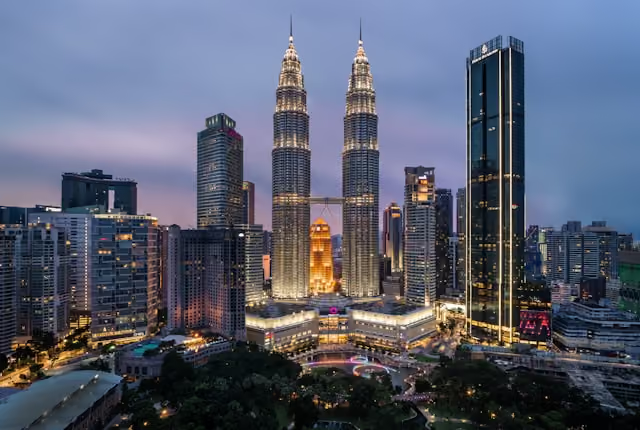
For visitors exploring KL's most popular sites — the Petronas Twin Towers and KLCC Park, the Batu Caves Hindu temple complex north of the city, the Central Market and Chinatown's Petaling Street, the Bukit Bintang shopping and dining corridor, and the Lake Gardens (Perdana Botanical Garden) — sealed bottled water is the universal hydration source. Malaysia's tropical climate produces year-round heat and humidity with average temperatures of 28–32°C, making adequate hydration from safe sealed sources a genuine health priority throughout any KL visit. Spritzer and Natural branded bottles are available at 7-Eleven and 99 Speedmart outlets within metres of virtually every KL tourist attraction.
For day trips from KL to the Batu Caves, Putrajaya, Malacca (Melaka), the Cameron Highlands, or Genting Highlands, the same water safety approach applies throughout peninsular Malaysia. Tap water is not recommended for drinking at any destination throughout Malaysia, and sealed bottled water is the consistent recommendation for all visitors regardless of destination, accommodation type, or length of stay.
Bottled Water Information
Bottled water is universally available throughout Kuala Lumpur at all convenience stores, supermarkets, and hotel shops. Spritzer, sourced from natural springs in Taiping, Perak, is Malaysia's most popular and widely available still mineral water brand. Natural, Cactus, and Evian are also widely available. A 1.5-litre bottle of Spritzer costs approximately MYR 2–4 (around AUD $0.60–$1.20) at 7-Eleven, 99 Speedmart, and Jaya Grocer stores across the city. At tourist-area restaurants and hotels in KLCC, Bukit Bintang, and Bangsar, prices are higher. Large-format 19-litre dispenser deliveries are standard in KL homes and offices and are the most economical solution for apartment stays.
Is Ice Safe in Kuala Lumpur?
Ice safety in Kuala Lumpur is generally acceptable at established venues. Hotels, shopping mall food courts, and tourist-facing restaurants throughout KLCC, Bukit Bintang, and Bangsar use filtered or commercially produced ice that is safe. KL's famous hawker stalls and mamak restaurants — including the legendary venues on Jalan Alor and around Masjid India — typically use commercially produced ice from regulated factories, which is generally safe. At very informal street stalls in older shophouse districts, ice provenance is less certain. The practical rule in KL: established venues and hawker centres — generally safe; very informal street stalls — caution advised.
Should You Use a Water Filter in Kuala Lumpur?
A water filter is a practical option for longer stays in Kuala Lumpur. Many KL expatriates in Mont Kiara, Bangsar, and Damansara Heights use installed reverse osmosis or multi-stage countertop filter systems, available from Harvey Norman, AEON, and online retailers throughout the city. For short-stay visitors, bottled water is the most convenient solution. The 19-litre dispenser delivery system is the most economical water solution for apartment or serviced residence stays of a week or more throughout the KL metropolitan area.
Should You Boil Tap Water in Kuala Lumpur?
Boiling Kuala Lumpur tap water kills biological contaminants but does not address the heavy chlorination, chemical residues, or sediment introduced by an aging distribution network serving one of Southeast Asia's most densely populated urban corridors. Bottled water is universally available across KL at very low cost and is the far more practical solution for all visitors.
Questions!
Is tap water safe to drink in Kuala Lumpur?
Not recommended. Tap water in KL is treated by Air Selangor to Malaysian national standards but is not considered suitable for direct consumption by visitors or residents. Heavy chlorination, aging distribution pipes, and occasional discolouration make it unpalatable. Use sealed bottled water or hotel-provided water throughout your stay.
Why don't KL residents drink tap water if it's treated?
The combination of high chlorination levels, aging pipe infrastructure across a sprawling metropolitan network, and the very low cost of bottled water means virtually no resident drinks from the tap. Bottled water, dispenser deliveries, and reverse osmosis home systems are the universal standard across all socioeconomic levels in KL.
Is ice safe in Kuala Lumpur restaurants and hawker stalls?
At established hotels, shopping mall restaurants, and tourist-facing venues throughout KLCC and Bukit Bintang, ice is produced from filtered or purified water and is safe. At local hawker stalls and mamak restaurants, ice is generally commercially produced and safe. Use caution at very informal street stalls in older parts of the city where ice provenance is unclear.
What is the best bottled water brand in Kuala Lumpur?
Spritzer, from natural springs in Taiping, Perak, is Malaysia's most popular and trusted still mineral water brand. It is available at every 7-Eleven and 99 Speedmart across the city for approximately MYR 2–4 per 1.5-litre bottle. Natural and Cactus are also reliable Malaysian brands widely available throughout KL.
Is tap water safe in other Malaysian cities like Penang or Johor Bahru?
No. Tap water is not recommended for direct consumption throughout Malaysia. The same advice applies in Penang, Johor Bahru, Ipoh, Malacca, and Kota Kinabalu. Use sealed bottled water for all drinking and tooth brushing throughout any Malaysian itinerary.
We don't conduct independent water testing. We summarise and interpret publicly available official data. Conditions can change rapidly — always verify with local authorities before travelling.
📚 Official Resources & Further Reading
World Health Organization (WHO) – Drinking Water Safety Guidelines
Centers for Disease Control and Prevention (CDC) – Malaysia Travel Health Advice
Australian Government – Smartraveller Malaysia

.svg)
